
Trouble-shooting Cochlear Implants Day-to-day Management, including FM Systems
Presented on 27 February 2008
Overview of CI Systems
Chris Durst; MED-EL UK Ltd
Functioning of the Hearing Ear
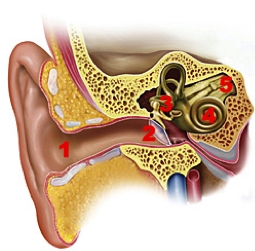
1. Sound gathered by pinna and travels down
ear canal
2.
TM vibrates in response
3.
Vibrations transferred by ossicles
4.
Causes pressure wave (travelling wave)
in fluid in cochlear
5.
Hair cells respond to this, causing firing of the
auditory nerve
Hair Cells – Travelling wave => Neural activity
- Inner hair cells (IHCs) – detect travelling wave. Higher level => more IHC activity.
- Outer hair cells (OHCs) – amplify low levels and condition travelling wave.
- - OHCs Improve frequency selectivity:
- High levels at one frequency can mask (swamp) lower levels at a nearby frequency – OHCs lessen this effect
Frequency (Pitch) Information
1) PLACE – different areas of the cochlear respond best to different freq's. Therefore different freq's cause different patterns of active fibres in the auditory nerve.

2) RATE – the firing pattern of the nerve approximates the freq'(s) of the arriving sound – phase locking.

Level (Loudness) Information
- Mechanisms are slightly less clear than for frequency.
- Higher level => Higher firing rates of nerve fibres
- Higher level => "Spread of excitation" – more nerve fibres active (or more phase locking)
- Complex phase information from different locations in the cochlea may also play a role.

CI Ear – loudness/level coding
- Mechanism is probably increased number of nerve fibres activated with increasing current level.
- Similar to major loudness coding mechanism in normal hearing.

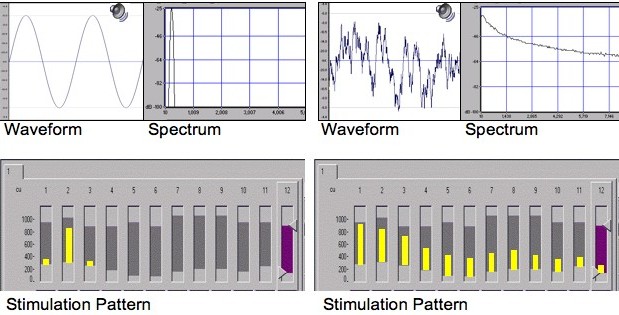
Frequency Information in CI: 1) PLACE
- Incoming sound split into frequency bands.
- Lower freqs result in pulses on apical (deeper) electrodes
- Mid freqs cause pulses on mid-depth electrodes
- Higher freqs result in pulses on basal (shallow) electrodes
- ..but stimulation can 'spread' from one electrode site to another – 'crosstalk' / 'channel interaction'.
- Place info. in CIs is relatively good cf rate info
- Depending on electrode length, and
placement in the cochlear, there may be tonotopic mismatch.
?'acclimatisable'?

Frequency Information in CI: 2) RATE
- Most current speech coding strategies
use envelope extraction
envelope = relatively slow changes in intensity - Early experience showed
that envelope was important for speech in quiet
In noise??
Music?? - RATE info in CI (for env extraction) relatively poor
- Efforts underway to transmit Fine Structure

The MAP
- The nerve responses typically vary between individuals and by channel/electrode number in the cochlea.
- The MAP is a set of individualised THR and MCLs for each channel.
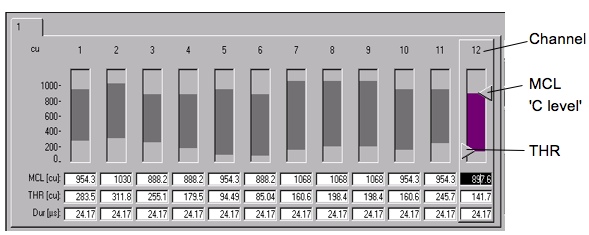
MAP in action
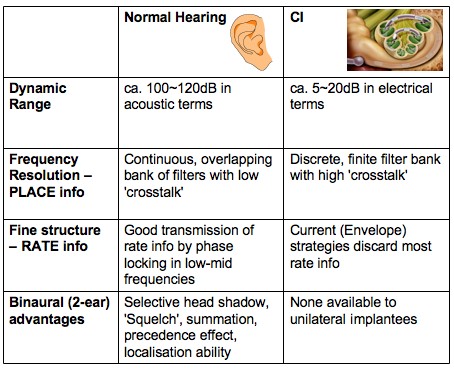
Limitations of CI ear

Conclusions
- The implant system transforms acoustic signals into electrical pulses, sent to electrodes in the cochlea and picked up by remaining neural tissue.
- This results in limitations compared to normal hearing
eg;
- Reduced frequency resolution (selectivity)
- Reduced dynamic range
- (that is, both familiar from SNHL)
- Limitations in transmission of rate (pitch) cues - Manufacturers are constantly
researching ways to improve upon these limitations
- eg; MED-EL FSP coding strategy in OPUS processors