
Introducing children to Low Vision Aids
Thursday 19 April
Low Vision Aids: Recall
Janis Sugden April 2007
Current Policies
ALL children in mainstream with very few exceptions.
It is of the utmost importance that any potential barriers are removed
LVA’s can be beneficial yet less than half use them. WHY?
Frequency of LVA use
Low Vision Aids Use (LVA) in Children with Visual Acuity < = 6/18 and >1/60
| Source of Information | Number of Children | Number using LVA | Percentage Using a LVA |
| Parents | 216 | 86 | 40% |
| Teachers | 154 | 64 | 42% |
Age Group
Only one pre school child
- 74% of primary children (9-10 years)
- 33% of 11-12 year olds
- 72% between the ages of 13 -16
Visual Acuity Groups
- As visual acuity becomes poorer a greater percentage of children reported to use LVA’s.
- This trend dips in the poorest visual acuity group.
- Pupils with no additional disabilities are more likely to be using LVA.
Educational Placement and Use of LVA’s
| Type of Placement | Total No of Children |
Number using a LVA | Percentage using a LVA |
| Pre-school | 31 | 1 | 3% |
| Mainstream Pr | 87 | 48 | 55% |
| Special Pr | 9 | 2 | 22% |
| Mainstream S | 22 | 13 | 59% |
| Special S | 5 | 0 | 0% |
| Total | 154 | 64 | 42% |
WHY?
- Inconsistent use of LVA between home and school and during transition from primary to secondary.
- Children of a developmental age of 2-3 years can be taught to use LVA.
- Cross discipline and coherent service delivery required.
Training
- TIME AND ENCOURAGEMENT
- Basic Training for Children in the use of LVA
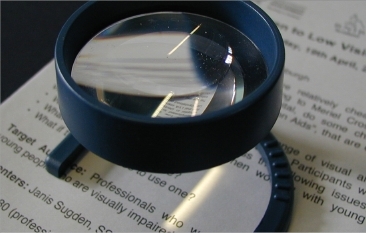
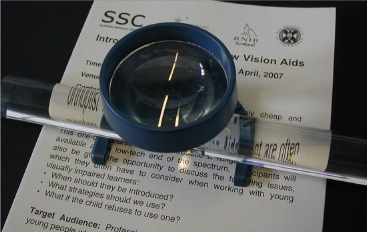
Stand & Hand Magnifiers
- Scratches = dirty lens = degrading image quality = poorer vision.
- Use correct spectacles.
- Is VIP right or left handed?
- Which eye has best acuity? Use it!
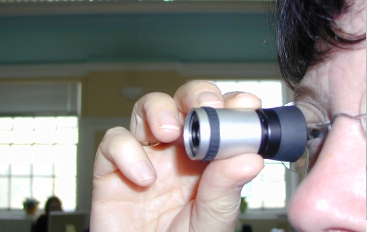
Telescopes
- Possibly the most difficult to adapt to.
- Small field of view makes locating the object of regard difficult.
- Depth perception: objects appear nearer and closer together than they are.
- Requires a steady hand (blurring)
CCTV
- Wide range available.
- Portability?