
Functional Assessment of Vision
Presented 19-20 March 2008
Functional Assessment for Children with Additional Support Needs / Case study
Dr Aisla Sinclair, SGCP, Co-ordinator VISSCC
Ms Christine Stones, PT/TVI, Stirling Council
Functional Assessment of Vision
1. VISSCC.
2. The need for assessment.
3. Sight and the seeing brain.
4. Assessing
5. Reporting (Case Study)
1. VISSCC
Visual
Impairment
Support
Service for
Children in the
Community
- Multi-agency group
- Support for visually impaired children and their families
- Share information between Health (Eye Clinic and Paediatrics) and liaise with other professionals
- Functional Vision Assessment
Year 2000 for 3 years
1. Provide an information and contact service for visually impaired children
and their parents.
2. Work towards ensuring that services provided are equivalent in all areas
of Scotland.
3. Identify the causes of visual impairment in Scotland and therefore aid
research into prevention.
- 333 notifications significant VI (700+)
- Of the visual system the BRAIN was the single most common site of VI… 47%
- 86%... Have additional disability
- Of 333 – 18% associated with Cerebral Palsy … Not enough!
- 70% of children with Cerebral Palsy have VI.
Cerebral Visual Impairment
- Development
- Evolution
- Reflex Vision
- Conscious Vision

Dorsal Stream Occipital to Parietal (Movement) to Frontal Decision Lobes
- Parallel processing
- Selective attention
- 3D position and moving through space
- Boundaries, steps
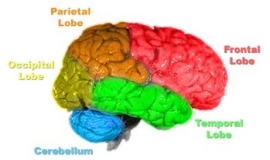
Ventral Stream Occipital to Temporal lobes (Visual memory)
- Recognition
- Face
- Shape
- Form
- Route finding
Control of Eye Movements
- Squint
- Nystagmus
- Dysmetric saccades
- SIF (occulomotor dyspraxia)
- accommodation
Periventricular Leucomalacia
Most common visual disorder in the developed
world
Damage to foetus at 22 – 34 weeks
- Nystagmus
- Eso/Exotropia
- Inaccurate saccades
- Visual acuity reduced
- Lower visual field impairment
- Crowding
- Disorders of higher visual function - simultaneous perception,
recognition, visual memory …
(dorsal stream more commonly than ventral stream)
2. Functional Vision Assessment Clinic Aim
Establish what is the child's functional vision
- How is it used?
- How do we enhance FV potential for:
Communication
Access to learning
Mobility - To answer questions from
Parents
School staff
Medical colleagues
Functional Vision Assessment Clinic
A – Preliminary work
- Referral to VISSCC.
- Discussed at VISSCC meeting – held monthly.
- Gather known history.
- VISSCC co-ordinator invites Parents to attend clinic with child.
- Other relevant people invited
- Venue chosen to suit child.
Information Gathering
- TVI and CT
- Multi-disciplines together
- Carers' Questionnaire
Functional Vision Assessment Clinic B – Clinic – 1 – 1 ½ hrs
Part 1. Professionals meet initially 15 – 20 mins.
- Paediatrician informs re medical and developmental background
- Orthoptists share Ophthalmic history
- TVI shares Education history
- Questions determined about what we are looking for in assessment
Part 2. Child and Parent join meeting.
Part 3. History gathered from Parent by VISSCC co-ordinator.
Functional Vision Assessment Clinic
Part 4. Functional Vision History
- Visual Problems as Perceived by Carers.
- Recognition.
- Mobility/Depth perception
- Orientation.
- Perception of Movement.
- Recognition of Objects against a complex background.
Functional Vision History
Visual Problems as Perceived by Carers.
Does the child:
- Follow movement around the room?
- React to light being switched on/off?
- Screw up eyes to bright light?
- Return a silent smile? – distance?
- Become excited when a drink cup is placed in front?
- Aware of themselves in the mirror? – distance?
- Reach for toys? – noisy/silent, size/distance?
- See better on one side or the other?
- East food from one side of the plate only?
- Bump into things one side or the other?
Recognition
Does the child recognise:
- Carer before they speak? – other family/friends?
- People in photographs including themselves?
- Objects?
- Shapes?
- Colour?
Mobility/Depth perception
Does the child:
- Trip over objects placed in front?
- Bump into things?
- Misjudge doorways? – which side?
- Have difficulty in distinguishing a line from a step / changes in surfaces?
Orientation
Does the child:
- Find their way around home/school?
- Find their way around new surroundings?
- Lose objects in the house?
Perception of Movement
Can the child:
- See moving objects or only stationary ones?
- Watch television? – which programmes?
- See objects when they are moving quickly eg; see out of car window?
Recognition of Objects against a complex background
Can the child:
- Pick out objects on a patterned carpet?
- Identify objects in complex pictures?
- Cope with a large number of choices?
Functional Vision Assessment Clinic
Part 5. The Assessment
Observed Visual Behaviour
- Abnormal head posture
- Head movements
- Preferred direction of fixation
(eyes deviated in a particular direction)
- Blink – flash/threat
- Light perception
- Fix and follow light (head held/not held)
- Direct eye contact
- Return silent smile
- Turn head/eyes towards - pen - bright light - coloured light
Tested Visual Behaviour
- Pupils
- Visual Acuity
- Contrast Sensitivity
- Visual Fields
- Orthoptic Examination
- Colour Vision
- Cone Adaptation Test
- Detection Vision
- Recognition Distances
Tested Visual Behaviour
- Orthoptic Examination
- Pupils
- Cover Test
- Eye Movements
- Saccades
- Binocularity
- Nystagmus
- OKN Response
Part 6 Conclusions and Recommendations
Discussed initially with
- Parent.
- Parent and child leave.
- Further detailed discussion, gathering all observations.
Functional Vision Assessment Clinic C - Report
1. Report is compiled
by VISSCC co-ordinator.
2. Report is discussed at next available VISSCC meeting. Final changes
made.
3. Report sent to Parents and relevant Professionals.
Case Study
A case study of a child from Stirling Council, assessed by the Visual
Impairment Support
Service for Children in the Community (VISSCC) Team.
References:
1. Assessing Functional Vision – children with complex needs. Catherine
Southwell, RNIB 2003
2. Vision for Doing – Assessing Functional Vision of Learners who are Multiply
Disabled.
Stuart Aitken & Marianna Buultjens, Moray House Publications, 1992
3. Approaches to working with Children with Multiple Disabilities and a
Visual Impairment, VITAL
4. Learning Together Mary Lee & Lindi McWilliam, RNIB
5. Cerebral Palsy and Visual Impairment in Children: CPVI Working Group/SSC/Bobath
CTC, SSC 2003
Dr Aisla Sinclair, SGCP, Co-ordinator VISSCC
aisla.sinclair@fvpc.scot.nhs.uk
Ms
Christine Stones, PT/TVI, Stirling Council
stonesc@stirling.gov.uk