
The Role of Vision in Learning
Presented on Friday 7 November 2008
Perceptual Aspects of Reading
Nadia Northway
PhD BA DBO SRO
Perceptual Apects of Vision
Investigate how the brain uses visual information or is affected by visual information.

Meares-Irlen / Visual Stress
What is it?
Pattern and flicker sensitivity. Triggered by 3 things:
1. Patterns or
stripes
2. Flicker from lights or VDU
3. Glare from light sources
NB everyone can experience visual stress if conditions are right
??Link with reading
Stripes

Current understanding of MIS
- Linked strongly with neurological disease such as migraine and epilepsy.
- Brain studies have shown that there is excess excitation in the brain in one of the visual centres and colour can be used to shift stimuli to non excitable area.

Intuitive Overlays/ Coloured lenses
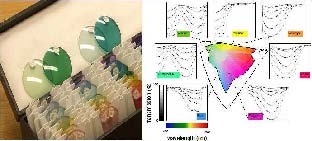
Appearance of text

Confirming diagnosis
- Rate of reading test
- Visual stress index
- Pattern glare test
- Developmental eye movement test
Symptoms
MIS
- Fatigue
- Headache
- Print distortion
- Blurring
- Difficulty with small print
- White Board
- Print moves and jumbles
Treatment- Coloured overlays and Lenses
BV anomaly
- Fatigue
- Headache
- Print Distortion
- Blurring
- Difficulty with small print
- Double vision
- Print moves and jumbles
Treatment - Orthoptic treatment and specialised glasses
Why do words move?
- Poor convergence - eyes move in and out
- Poor accommodation - like zooming in and out with camera lens
- MIS - perceptual distortion
- Temporal processing anomaly
- Spatial processing anomaly
- Unsteady eye movements
- Magnocellular deficit - poor fixation
- Reader moves!
Visual Perceptual Assessment
Assesses seven areas of visual perception including visual memory and
visual sequential memory.
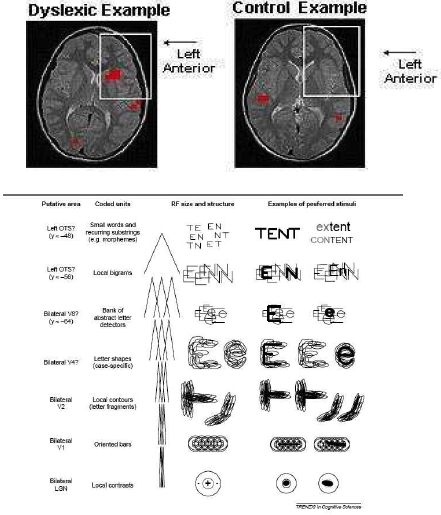
Visual Perceptual Difficulties
- Visual Memory
- Visual Discrimination
- Visual Figure Ground
- Visual Sequential Memory
- Visual Form Constancy
- Visual Spatial Relationships
- Visual Closure
Visual Discrimination
- Purpose - to determine if the patient can find objects with a similar shape
- 16 plates (4-13) , 12 plates 13>
- Shapes become more complex and choices become more alike
- If poorly developed- problems developing sight word vocabulary, difficulties recognising similar words eg; far and for


Visual Memory
Purpose - ability to remember a single object or shape.
16 plates (4-13) , 12 plates 13>
If poorly developed- problems developing sight word vocabulary, difficulty with spelling - will not see that word is incorrectly written, difficulty copying - slow and must look up and down a lot.
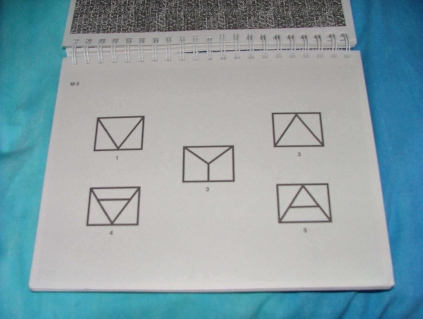
Visual Spatial Relationships
- Purpose - to determine if patient can see odd shape out - odd shape has been rotated.
- If poorly developed - possible b and d confusion, difficulty with writing, spotting written errors

Visual Form Constancy
- Purpose - to identify an object which is varied in size, or rotation
- If poorly developed - problems identifying words that may be written in different fonts or forms, doesn't recognise words from one page to next

Visual Sequential Memory
Purpose - to identify a sequence of shapes.Sequence increases from 2- 9 shapes.
Timed task-
- 2-3 shapes- 5 seconds
- 3-5 shapes- 9 seconds
- 6-7 shapes- 12 seconds
- 8-9 shapes - 14 seconds
- If poorly developed - difficulties with spelling, copying, times tables


Figure Ground
- Purpose - to discriminate a shape from background information. Have to maintain an awareness of the relationship of this shape to the background information
- If poorly developed: difficulty as print size becomes smaller, attention in busy classroom, clutter on desk.


Visual Closure
- Purpose - to see if patient can interpret visual information when incomplete
- Asked to find shape which will be the same as the target shape if all the lines were joined
- If poorly developed - reading fluency problems, slow reading, word recognition slower and poorer.


Testing method
- It is important not to give feedback on performance although general
encouragement is
good - Continue until 4/5 or 3/4 incorrect response
- Calculate raw score
- Use conversion table to find PR etc
- < 25% is considered is abnormal and requires
treatment - Also look for discrepancy
Frostig Developmental Test
- The Frostig Developmental Test of Visual Perception is also known as the Marianne Frostig Developmental Test of Visual Perception and the DTVP.
- It is a test widely administered to children in pre-school children up to age 7-8.
- It can diagnose possible learning disabilities or neurological disorders
by assessing perceptual skills
(visual perception and hand-eye coordination). - Children are generally referred for the test by special education teachers, occupational therapists, or psychologists.
DTVP
The DTVP can be administered individually or in groups.
It consists of 41 tasks arranged in order of increasing difficulty on demonstration cards and is designed to evaluate the child's visual skills in the following areas: eye-motor coordination (drawing continuous straight, curved, or angular shapes); figure-ground perception (detecting embedded figures); constancy of shape (distinguishing common geometric shapes); position in space (identifying reversed position); and spatial relations (connecting dots to form shapes and patterns).
Test results are evaluated in relation to standard first-grade reading skills.
Raw scores for each subtest are converted to age scores and scaled scores. The scaled scores for all five subtests are then combined for a total test score, which is divided by the child's age to produce a perceptual quotient. Guidelines are provided for scores considered necessary to first-grade readiness.
While the DTVP can be an indicator of learning disabilities, the test by itself is not a definitive indicator of learning disorders, nor do high scores on it rule them out.
Young children may need more than one session to complete the test, which has also been adapted for the hearing-impaired and non-English-speaking children.