
Eye conditions and case studies
Presented on 28 October 2011
North Lanarkshire Council Department of Education Sensory Support Service (Vision) Presented by Alison Attwood and Carol Ferguson
The Support Framework
Context of Support
- Knowetop Visual Impairment Unit
- Peripatetic Service
Knowetop Visual Impairment Unit
- School Background
- Unit/Resource Base Setup
- Staff
- Support for Inclusion
Peripatetic Service
- Support to home, nursery, primary and special schools
- Support across two local authorities.
- Role of the Visual Impairment Assessment Team
- The referral system – Request for Assistance
- Nature of Support
Support for Inclusion
- Consultation, advice and support to staff, pupils and parents
- In-Service training
- Preparing appropriate resources – enlarged print, Braille, tactile diagrams
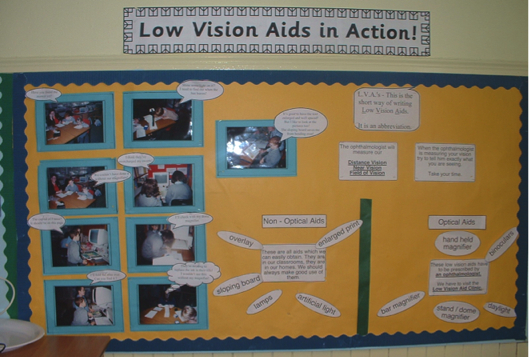
- Training in use of Hi-tech and Lo-tech aids
- Working together with other agencies
Working Together!
Functional Vision Clinic
- Joint assessment – each discipline brings their knowledge and understanding of the child
- Parents share their wealth of experience of their child in a relaxed environment
- One appointment under one roof
- Enables better support of child in school
Low Vision Clinic
- Low Vision Aid clinic for children – Gartnavel Hospital
- Lanarkshire Low Vision Project – will provide local provision more quickly
- Teachers can identify children who need low vision aids and then support the use of these aids
Case Study
Andrew
- Referred in his Primary 2 year at school.
- New referral carried out by a QTVI.
- Termly visits deemed appropriate.
- September 2010 assessments indicated condition appeared stable.
- January 2011- assessment and observation indicated a deterioration.
- Call mum.
- Referral to mobility officer.
- Letter to ophthalmologist.
- Review in School.
- Advance of RP and also macula oedema.
- Within the space of 5 months Andrew's vision had significantly reduced.
- Visits increased to thrice weekly.
- Carol will now discuss the support put in place.
Support
- Initial support very trial and error
- Two visual conditions which indicated very different support strategies
- Enlargements/reductions
- Visualiser
- Sloping board and appropriate lighting
- Evaluation of support due to further deterioration of vision
- In-school awareness raising
- School and class organisation
- Full-time support assistant in place
- Weekly liaison and planning with class teacher
Specialised Support
- Braille
- Type to Learn
Important to avoid overload!
Curricular support
- Keeping apace with the Primary 6 Curriculum
- Literacy
- Numeracy Other
- Curricular areas
Resources
- Raised square paper
- Tactile diagrams
- German film
- White board/black pen
- Concrete materials eg; magnetic fractions
- Talking calculator
- Raised dice
- Raised dominoes/games
- Slade buttons
- Wikki sticks
Future Planning
- Transition review
- Technology required to help smooth transition to Secondary
- Smooth transfer back into full class lessons, using braille as work medium
- Class awareness-raising
Key to Success
- Observation, taking the lead from your pupil
- Trial and error, learning from your mistakes
- Liaison and planning
- Evaluation
- Supportive school environment