
Functional Assessment of Vision
Presented on Friday 5 May 2006
Lesley Reid
Teacher of the Visually Impaired,
Inverclyde
Assessment of Visual Acuity: Tests and Procedures
Visual Acuity Definition
"the ability to discriminate high contrast fine
detail at a distance; the sharpness and clarity of vision"
(Mason, 1997)
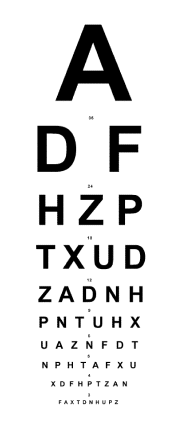
Snellen Test Type
- The most commonly used test to assess distance VA.
- Dutch ophthalmologist Hermann Snellen (1834-1908)
- One single letter (optotype) at top of chart.
- Rows of letters (optotypes) decreasing in size towards bottom of chart.
Example of a Snellen Test Type
How to use the Snellen chart
- Know your testing distance.
- Note if spectacle correction worn.
- If appropriate, occlude one eye.
- Ask child to read down chart as far as they can.
- Check child is not leaning forward to see better (reducing testing distance) or 'peeking'.
If necessary, point to each letter. Ensure you finger is straight and
directly below the letter you are asking them to read.
When child is reaching their limit encourage them to attempt letters on the end of the next row. These are often easier to see than letters in the centre of a row due to the crowding phenomenon.
Recording Snellen Results
- Results are recorded as a fraction.
- Top number equates to the distance (in metres) at which the test chart was presented (usually 6m),
- Bottom number identifies the position on the chart of the smallest line read by the 'patient'.
- Eg; 6/60 means the subject can only see the top letter when viewed at 6m.
Can record parts of a line read by using e.g. "6/12 part" or "6/18+1"
or "6/6-3"
(Remember to record whether or not glasses worn during test.)
Snellen recordings
| 6/60 | Top line (1 letter) |
| 6/36 | 2 letters |
| 6/24 | 3 letters |
| 6/18 | |
| 6/12 | |
| 6/9 | |
| 6/6 | 7th line (approx7 letters) |
| 6/5 | (not included on all test charts) |
| 6/4 |
Development of Visual Acuity
- Newborn 6/240
- 6 months 6/60 - 6/24
- 18 months 6/9
- 4 years 6/6 (linear)
Disadvantages of Snellen Test Type
- Letters not of equally legible eg; O and E
- Non-uniform progression of letter sizes
- Unequal number of letters on each line
- Irregular spacing between letters and lines
- Inadequate scoring (6/9+2, etc)
RESULT= Inaccurate results, especially for those with low vision.
The LogMAR alternative to Snellen
Bailey & Lovie (1980)
We have designed ... a series of near vision charts
in which the typeface, size progression, size range, number of words
per row and spacings were chosen in an endeavour to achieve a standardization
of the test task
LogMAR
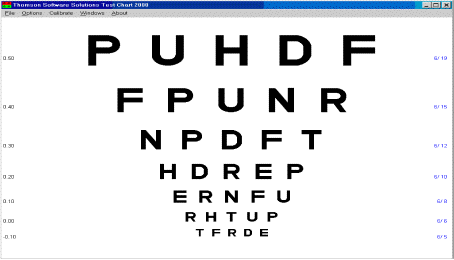
Other researchers suggested a logarithmic progression in size of letters on test chart gives most accurate VA measurement
MAR=Minimum Angle of Resolution
-the angle subtended within the eye by a letter
How does LogMAR relate to Snellen?
- Letter E on 6/6 line subtends an angle of 5 minutes of arc; each limb subtends 1 minute of arc
- Minimum Angle of Resolution for a 6/6 letter is 1 minute of arc.
-the log of the MAR for a 6/6 size letter is 0
Scoring LogMAR
- Each letter has a score value of 0.02 log units; 5 letters per line
- Each line represents a change of 0.1 log units
Advantages of LogMAR
- Equal number of letter per line
- Regular spacing between lines and letters
- Uniform progression in letter size
- Final score based precisely on total of all letters read
- Finer grading scale allows greater accuracy and improved test/retest reliability
LogMAR / Snellen equivalent results
| LogMAR | Snellen | Decimal |
| 0 | 6/6 | 1.00 |
| 0.18 | 6/9 | 0.67 |
| 0.30 | 6/12 | 0.50 |
| 0.48 | 6/18 | 0.33 |
| 0.60 | 6/24 | 0.25 |
| 0.78 | 6/36 | 0.17 |
| 1.00 | 6/60 | 0.10 |
Other LogMAR VA tests
- LogMAR Crowded Test (at 3m)
- Kays Crowded Test
NB Crowded tests more accurate than uncrowded
Final thoughts
Use logMAR tests when possible, they give more accurate results.
The more you practise the more confident you will become.
When you are confident your children will relax and achieve their best
results.