Inclusive higher education for students with visual impairment in Indonesia

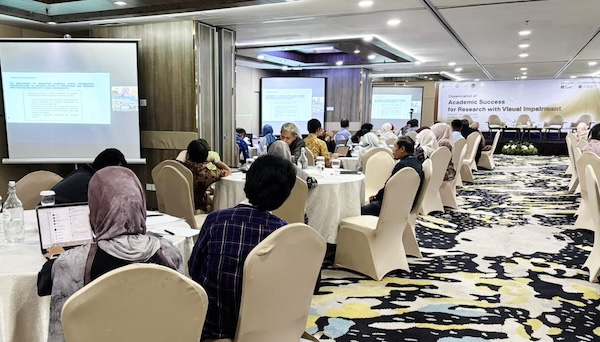
Universitas Al-Azhar Indonesia (UAI), in collaboration with Moray House School of Sport and Education, University of Edinburgh, Scotland, launched a dissemination and presentation of a policy brief entitled Promoting Academic Success for Researchers with Visual Impairment on Thursday, 21 May 2026, at the Grand-Dhika Ballroom, Jakarta. The event marked a significant milestone in efforts to promote inclusivity within Indonesia's research and higher education sectors.
In 2023, Indonesia was ranked as the country with the third-highest number of blindness cases in the world. Accessibility for people with visual impairments in the academic and research sectors remains severely limited amidst this worrying reality. Article 53 of the Law on Persons with Disabilities stipulates that government agencies and state-owned enterprises should employ at least 2% of people with disabilities, including in higher education establishments. However, the implementation of these regulations is far from ideal.
A collaboration between Universitas Al-Azhar Indonesia and University of Edinburgh identified three key challenges: (1) a lack of accessibility for individuals with visual impairments in postgraduate education; (2) a lack of technological support and accessibility in research; and (3) limited employment opportunities as researchers due to social stigma.
This policy brief proposes four concrete recommendations:
Higher education institutions must prepare to support new researchers with disabilities by providing dedicated HR staff, adequate assistive technology for research, and inclusive systems and regulations.
The official opening of the event was performed by the Rector of Universitas Al-Azhar Indonesia, Prof. Dr. Widodo Muktiyo. The seminar featured prominent speakers and panellists, as well as a keynote speech by Jonna Aman Damanik and a presentation of policy briefs and recommendations by Prof. John Ravenscroft from the Moray House School of Sport and Education, University of Edinburgh. There was also a presentation of findings by Cut Meutia Karolina, M.I.Kom (Indonesian Team).
Participants included government representatives, university administrators, and disability association and community members. Among them were:
This project is funded by a grant from the British Council's Going Global Partnership and is a collaboration between Universitas Al-Azhar Indonesia and the University of Edinburgh in Scotland.
Implementing this policy requires collaboration between various stakeholders, including government bodies, supervisory organisations, higher education institutions and journal editors in Indonesia. It is believed that this collaboration will have a significant impact on ensuring success and opportunities for people with disabilities, including people with visual impairments, as researchers at Indonesian higher education institutions.

Supported by funding from the British Council Going Global Partnerships programme. Going Global Partnerships supports universities, colleges and wider education stakeholders around the world to work together towards stronger, equitable, inclusive, more internationally connected higher education, science and TVET. Through international partnerships, system collaborations and opportunities to connect and share, we enable stronger transnational education, more collaborative research, higher quality delivery enhanced learner outcomes and stronger, internationalised, equitable and inclusive systems and institutions. This leads to stronger higher education, research and TVET systems around the world that can support fairer social and economic growth and address national and global challenges all backed up by mutually beneficial international relationships.
For further information, please contact: john.ravenscroft@ed.ac.uk or @cviauai on Instagram.

Opt out of Google Analytics cookies · Add/Update/Remove Your Contact Details · Privacy
©2025 Scottish Sensory Centre, Edinburgh