The Importance of the Role of the QTVI and Habilitation Specialists
in the Education of Children and Young People with Visual Impairment
Presented on Monday, 19th January 2026

in the Education of Children and Young People with Visual Impairment
Presented on Monday, 19th January 2026
Number of Participants: 61
Number of Respondents: 7
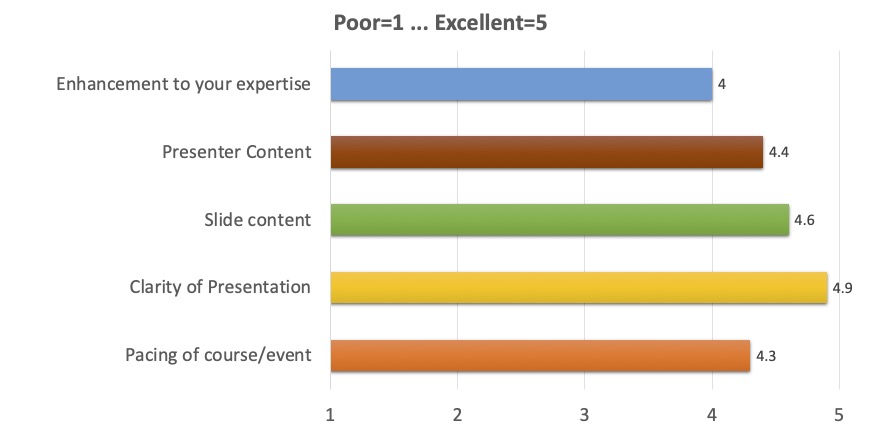
Reminder of the different legislation was particularly helpful.
SSC trying to extend their reach to decision makers/budget holders in local authorities. It was interesting that many local authorities outwith Scotland took part too.
I found the input on QTVI most relevant to my role.
Range of information.
Diagrams and models from a range of sources which can help to illustrate main points with references for further reading. It was also very helpful to receive the presentation so that we could use the links provided and rewatch at our own pace.
Legislation.
Being given up to date legislation as to duty of schools etc. to provide for needs of VI pupils, and the summary of specialist skills provided by QTVI.
Nothing. It would be helpful to have slides in advance to enable attendees to print them out and annotate during the webinar if they wish.
The content was entirely appropriate/ well targeted. It was a shame that VS Teachers largely didn't vocalise or contribute comments in the chat to back up the presenters who were advocating so well regarding the essential role VS Teachers bring to Scottish education!
Maybe I misread the purpose of the webinar. For qualified teachers of VI or hab, I am not sure what would have been new. The slides on legislation were very small and detailed for a quick look at the legislation pinning our work.
I found this very helpful and I can't think of anything else that should be provided.
Nothing else. (2)
I think the maximum amount of information possible was included within the time given.
SSC direct email: 5
Colleague: 2
Working with pupils with VI and complex needs.
1. Recent webinar on Artificial Intelligence for deaf/hard of hearing learners was excellent. Could SSC run something similar for VI educators? What benefits and considerations are there for this cohort of learners? 2. A session on using digital tools to aid screen mirroring of class smartboard content to learner iPads eg through Microsoft TEAMS, Google classroom, One Note or other commonly used platforms. Some local authorities are trying to move away from dedicated mirroring packages and steering ALL teachers to using inclusive tools available with ALL learners not just learners with visual access needs. Are there drawbacks to this approach? Do standard platforms offer 'skills for life' which are transferable to work places and are therefore preferrable? Lots to debate and I am aware of many VI Teachers looking to upskill. 3. It'd be worth periodically repeating the 'Role of the QTVI & Habilitation Specialists' webinar to capture those newly in managerial/decision making/budget holder roles. 4. Transition support for learners with VI moving onto Scottish College and Universities - experiences of current/past students (academic skills, academic supports and social experiences), tips for navigating Disabled Student Allowance application process, key contacts in Student Support Services, things to think about when arranging accommodation, key contacts and services available in the larger cities including Rehab support, VI specific social support networks, leisure activities etc. Discussions around things others have used Transition Scotland Fund funding on.
A Scottish focus on how authorities are implementing the CFVI. How to manage caseloads effectively. Time with an ophthalmologist to look at specific common conditions.
Always more information on latest research/best strategies to use for pupils with CVI, especially CVI with additional support needs.

Opt out of Google Analytics cookies · Add/Update/Remove Your Contact Details · Privacy
©2025 Scottish Sensory Centre, Edinburgh